I created a side project to grow as a developer. It became something I am proud of
2026-07-13
thebest.ink
2026-07-13
A year ago I started a side project. The public reason was a real problem. Finding a tattoo artist who cares about your tattoo is harder than it should be. The good ones are overbooked, and when you search, you get a list of studios with no way to compare them.
The private reason mattered more to me. I wanted to grow as a developer, and for that I needed a real problem, not a tutorial. This is what a year of that looked like, and what it taught me.
When I started, the whole thing looked simple. A Django API and some kind of frontend. Let people search for studios by place and by style. That was it. I did not even plan to let users book appointments.
The simple idea was not simple. That gap is where most of the learning happened.
A search platform with an empty database is useless. Nobody visits, so no artist signs up, so there is nothing to search, so nobody visits. I could not wait for artists to fill it.
So I built the supply side first, before a single artist signed up. I wrote a pipeline that gets studios from a map provider. The first step gets the address, coordinates, and website. The second step reads each studio website as plain text and passes it to an LLM, which returns structured information: the artists, the styles, and so on. That data gets saved as a studio profile.
I designed the map provider to be interchangeable. I started with Google Maps, but the pipeline does not depend on it. I also made the region size configurable and kept a history of every scan, so I could grow the coverage area step by step instead of all at once.
The result is that when an artist arrives, their profile already exists. They claim it instead of building it. This is the part I am most happy with, because it solved a real problem and not a toy one.
Once search worked, a new problem appeared. Search for studios in Salzburg with the style Blackout and you might get six results. Which one do you pick? A plain list does not help.
I added a score from 0 to 100 based on reviews. The naive version, a simple star average, is unfair. A studio with one five-star review would beat a studio with fifty reviews at 4.8 stars. That is wrong. So I used a Bayesian ranking, which moves scores with few reviews toward the average until there are enough reviews to trust them. I called it the TheBest.Ink Index.
I kept telling myself this is only a side project. But if the goal was to grow as a developer, then building it carelessly would defeat the point. So I used the same practices I use at my job:
Here is what a year of that looked like.
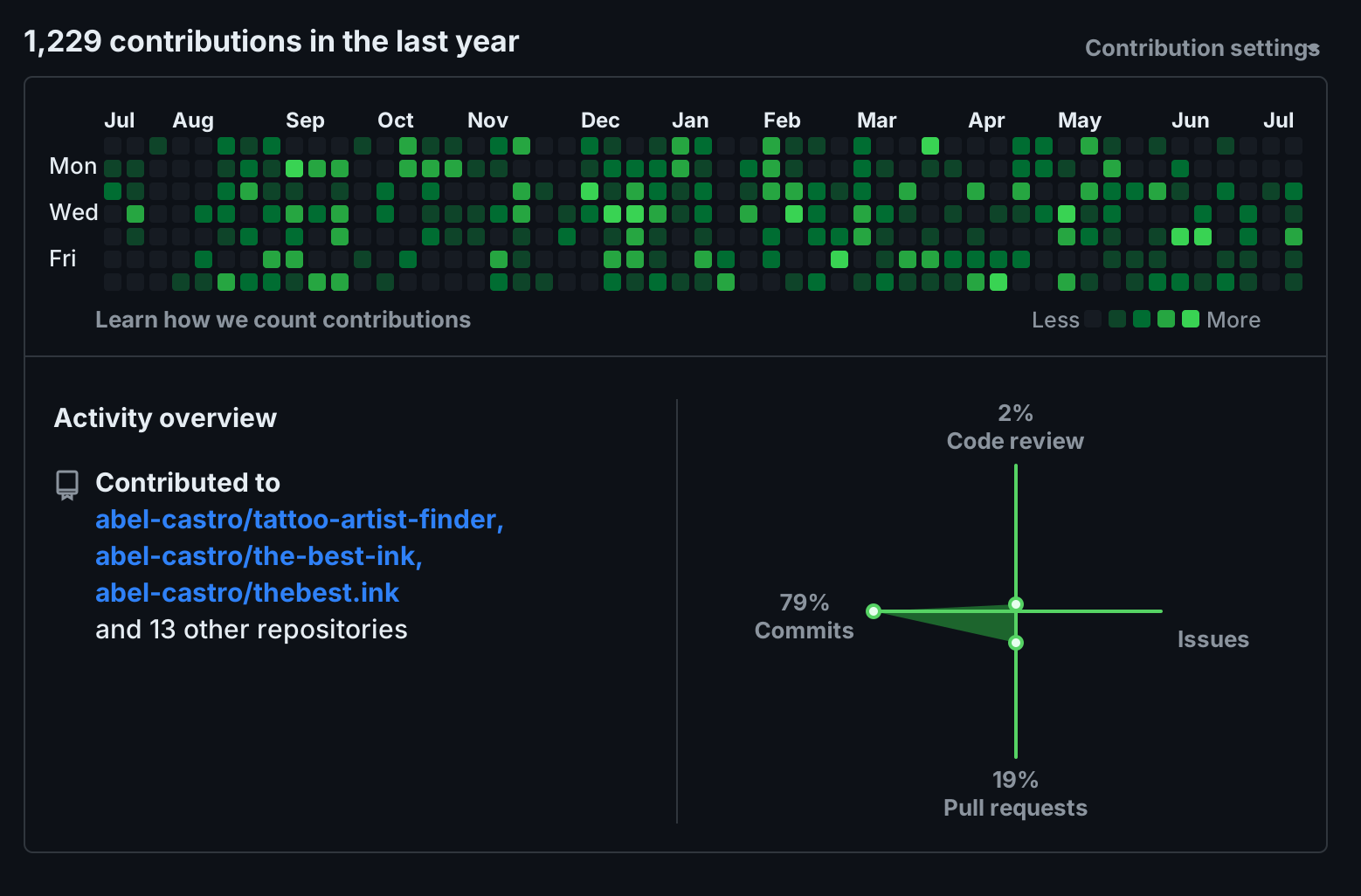
This is my GitHub activity for the last year. Around 97 percent of it is one private repository, TheBest.Ink. The gaps are real. This was spare-time work, at night, early in the morning, and on some holidays, next to the job that pays the bills.
As the project grew, the number of cases became hard to keep track of. Discovery generates profiles, artists claim them, users send requests, artists accept, users leave reviews, artists reply. Each of those has edge cases.
I wrote most of the code and docs AI-assisted, as if I were working in a team with other developers. That changed how I think about two things.
The first is documentation. The same document has to serve a human who is new to the code and an agent that needs context to do the work. Keeping two separate sets of docs means they drift apart. The second is project layout. The project started as four separate repositories, and both I and the agents kept losing context when moving between them. Merging everything into one monorepo fixed that. The agent could see the whole codebase, and so could I.
I wrote two posts about what I learned there: "Customer Journeys Belong Next to Your Code" and "The Problem With Splitting Human and Agent Docs".
The full flow works end to end and is covered by tests. Discovery creates a profile, an artist claims it and verifies they own it, the artist manages their data, a user sends an appointment request, the artist accepts, the user leaves a review, and the artist can reply. The design is becoming consistent across the apps, and the whole thing is starting to feel like a solid product.
Here is a short video of the product in use.
Finding a studio and its artists, then an artist profile with the artist's own data, reviews, and portfolio images.
The goal was to grow as a developer, and it worked. Along the way it became something I did not expect: a product I am proud of. A year ago it was an idea and a rough plan. Today it runs end to end, and I built every part of it myself. That is what I am happy about. You can try it at TheBest.Ink.